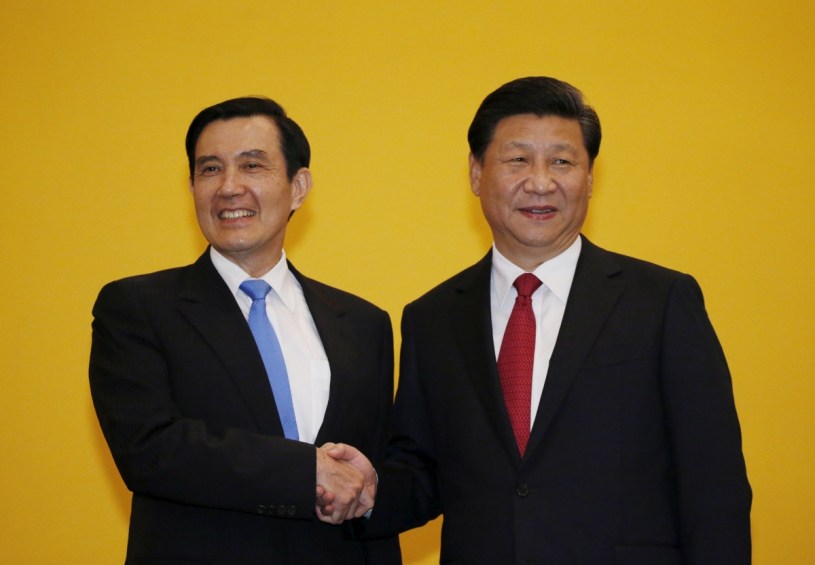
In a huge breakthrough for cross-strait relations, Taiwanese President Ma Ying-jeou and Chinese President Xi Jinping met in Singapore on November 7 to discuss the future of cross-strait relations. This meeting marks the first time the leaders of the Republic of China (Taiwan) and the People’s Republic of China have met since 1949.
According to press conferences held by both sides, there were no major breakthroughs during the meeting. Rather, the meeting was a reassurance of agreements that had already been made. Zhang Zhijun, head of the Taiwan Affairs Office, gave a 20-minute speech detailing Xi’s view on the “Taiwan Issue”. He reiterated the PRC’s strong stance against “separatism” and their firm belief in the “One China” policy under the 1992 Consensus, though strategically omitting the “Differing Interpretations” part.
Taiwan’s Ma, on the other hand, gave a brief summary of the meeting. During the meeting, he reiterated Taiwan’s support for the 1992 Consensus, explicitly emphasizing the “Differing Interpretations” aspect, and that there would be no Taiwanese independence or concept of “Two-Chinas,” as they are not permitted under the Constitution of the Republic of China. Ma also brought up other essential concerns such as China pointing 1500 missiles toward Taiwan, to which Xi responded that it was not “solely against Taiwan”.
In essence, though no major agreements were reached in this meeting, it served as a symbolic first step towards a new era of cross-strait relationships. For example, both sides set up “hotlines” across the strait for future governmental meetings, and discussed more possibilities for international trade pacts, especially in regards to Taiwan’s relationship with China’s Asian Infrastructure Investment Bank.
Undoubtedly, this bilateral meeting has huge political implications. Some speculate that the meeting gives Taiwan’s Kuomintang (KMT) Party much needed leverage for the upcoming presidential election, as it shows that the KMT is capable of maintaining a peaceful and advantageous relationship with China. With regards to China, the Communist Party also hopes that the meeting will give the KMT beneficial publicity among the Taiwanese people, as the opposition party, the Democratic Progressive Party, is much less inclined to maintain friendly Taiwan-China relations. However, many Taiwanese people see the meeting as the “selling of Taiwan to China,” and have taken to the streets in protest, causing analysts to believe that the meeting might actually cause the KMT to alienate voters.
Whatever the results, however, it does not change the fact that this historic meeting will be of great significance to the future development of both sides of the strait. As to how positive of an effect it will have, only time will tell.
 The Taiwan Perspective