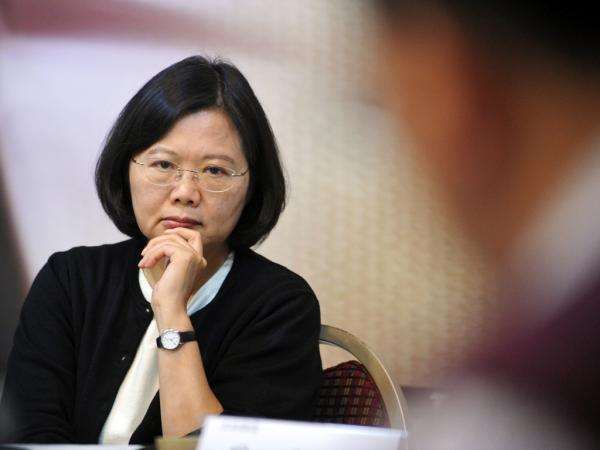
President-elect Tsai Ing-wen and her Democratic Progressive Party (DPP) made history this January after winning Taiwan’s presidential election by a landslide with 56% of the popular vote; not only did the DPP successfully unseat the ruling Kuomintang Party (KMT) from power, but Tsai will also become the first female president of the Republic of China, what Taiwan is officially called.
However, the honeymoon period may have ended for Tsai before she even stepped into the Presidential Palace, as several major challenges have already began piling up at her doorstep.
The first and most crucial of these issues is the souring cross-strait ties with Mainland China, formally the People’s Republic of China (PRC). Under outgoing President Ma Ying-jeou’s leadership over the past eight years, relations had exceptionally warmed across the strait. Commercial flights resumed shortly after Ma took office, free trade agreements were signed, and just last November, the two leaders of both sides met for the first time since 1949.
All of that progress is potentially one heartbeat away from being undone, however, as the PRC views the DPP and Tsai with great skepticism. For one, the DPP had previously rejected the “92 Consensus”, the bilateral agreement that there is only one China, but different interpretations on either sides of the strait, which serves as the cornerstone of maintaining a cordial cross-strait relationship. Instead, Tsai’s party has always toyed with the idea of “Taiwan independence”, a path that more and more Taiwanese, especially the young, have begun supporting, but outrages Communist China.
In fact, it enrages the Mainland so much that they have begun firing warning shots even before the DPP has even taken power. On March 17th, the PRC resumed diplomatic relations with Gambia, a former diplomatic ally of the ROC, and thus ending the unspoken “diplomatic truce” that began when President Ma assumed office.
If Tsai cannot meet the PRC half-way before she assumes office on May 20thand find her own alternative of the “92 Consensus”, then the Mainland will surely begin firing more than just warning shots.
Things do not look any brighter closer to home either. Taiwan’s economy continues to stagnate amid the global economic turmoil, with an annual growth rate of only 2% for the past decade, the lowest among the four “Asian Tigers”. Moreover, despite having a GDP per capita of over $46,000 as of 2014, most college graduates face the so-called “22k” dilemma, meaning their monthly salaries average only 22,000 New Taiwan Dollars ($710) a month. As a result, many youngsters are flocking to businesses abroad, greatly decreasing Taiwan’s talents and youth labor force.
Exports have also slowed in recent years, further stagnating the island’s export-dependent economy. Neighboring countries such as South Korea have been busy signing and benefitting from FTAs with key economic powers, but Taiwan is still struggling to get a piece of the cake due to its diplomatic status and the pressure exerted by Mainland China. Moreover, with nearly 40% of its exports headed towards the Mainland, Taiwan’s economy will surely end up in turmoil should the DPP fail to continue developing harmonious cross-strait relations.
Perhaps the biggest challenge for Tsai and her team, however, is maintaining their party’s reputation among the people. Ever since former President Chen Sui-bian was arrested on corruption charges just shortly after leaving office, the DPP has faced a long and difficult road in regaining the trust of the people. Tides have changed in recent years, with the DPP overwhelmingly winning all recent elections and even gaining the parliament majority for the first time in history, yet distrust still exists among the non-party aligned “median voters”. For one, despite running a campaign on change and fresh starts, many of Tsai’s senior staffs, are in fact the very same party elites from Chen’s government, including former-Premiers Frank Hsieh and Su Tseng-chang.
Even worse, insider trading allegations have recently surfaced around the head of the Academia Sinica, Wong Chi-huey, who was not only appointed when the DPP was still in power, but is also a close supporter of Tsai Ing-wen. While the case is still under investigation (Wong has refused to return to Taiwan and even tried to resign while in the United States), it has undeniably reminded people of DPP’s dark past, something Tsai must put a stop to once she assumes office if she is to regain the trust of the people.
Tsai and the DPP may have overwhelmingly surmounted the presidential and parliamentary elections, but their greatest challenges are still ahead. Not only do they need to revive a troubled economy and regain the people’s trust, but Tsai and her team will need to absolutely ensure that they find common ground in cross-strait relations in order for anything to count. Without a mutual understanding between the two sides, we may enter a period of unforeseen instability between the straits, and at that point, nothing else can redeem the consequences.

