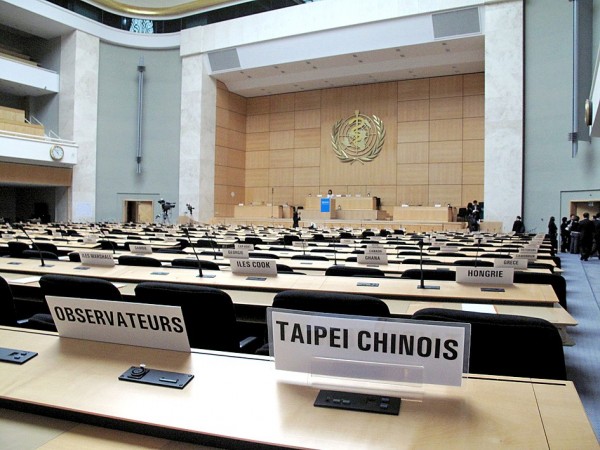
This past week, the Taiwanese government announced that it would ask its diplomatic allies to send a letter to the Secretary General of the United Nations (U.N.) to reaffirm its intention to “meaningfully participate” in U.N. bodies, namely the World Health Organization (WHO), the International Civil Aviation Organization, and the U.N. Framework Convention on Climate Change.
This isn’t the first time that Taiwan has applied for meaningful participation within the United Nations; in fact, the Republic of China (ROC), as the island nation is formally known, has been continuously applying to join the United Nations since 1993. What makes this specific application so noteworthy, however, are its implications.
First, it provides a glimpse at President Tsai Ing-wen’s foreign policy direction, which up to now has been rather vague. Since coming to office earlier this May, Tsai has been prioritizing domestic issues such as legal reform over foreign policy, asides from a short symbolic trip to Panama and Paraguay over the summer. However, she faces sharp criticism from both the opposition parties and the people for her lack of action on increasing Taiwan’s international presence, and her poll numbers seemingly reflect their displeasure, as her satisfaction rate has dropped 14 percent since she took office according to latest polls, prompting this latest move to apply for U.N. participation. While it has become common practice for Taiwan to try taking part in U.N. bodies, this particular attempt is the most aggressive in 7 years. Tsai’s predecessor, President Ma Ying-jeo, chose a more subtle, “behind-the-scene” approach in dealing with U.N. participation, relying mostly on warming ties with the People’s Republic of China (PRC) to gain access to certain bodies of the U.N., such as the WHO, which granted Taiwan observer status under the name “Chinese-Taipei” in 2009. However, compared to the efforts of President Chen Sui-bian, who tried attempted various times to apply for full U.N. membership as “Taiwan”, Tsai’s effort appears less radical, and much more careful and pragmatic. It shows that while Tsai’s government is taking a different foreign policy stance from that of Ma and his Kuomintang (KMT) party, they also aren’t bound by the radical policies from the Democratic Progressive Party (DPP)’s past, but is instead treading somewhere in between.
More importantly however, this move is meant to test the waters of relations with the PRC. Ever since Tsai took office, cross-strait relations have become chilly, with almost no communication between the two sides. This is mainly due to Tsai’s unwillingness to accept the “1992 Consensus”, an unofficial agreement between the the two sides back in 1992 that there was only “one China” with different interpretations on each side, something that angers the Beijing. However, the PRC has yet to take direct actions against Taiwan’s new government, instead resorting to indirect tactics, such as reducing the amount of Mainland Chinese tourists visiting Taiwan as a way of voicing its displeasure. However, with this latest move from Taiwan, Tsai’s government will most likely be able to see the full extent of discontent across the strait once the PRC reacts to its reapplication for U.N. participation. Should the PRC react similarly as it did for the previous eight years, then it would mean that Tsai would actually have more room for dialogue despite not recognizing the 1992 Consensus. However, in the likely scenario where the PRC reacts strongly, either by requesting to revoke Taiwan’s observer status in the WHO or barring Taiwan from taking part of next week’s ICAO meeting (which appears to be the case as of now), then the new Taiwanese government will most likely have to rethink their cross-strait strategy, or even consider accepting the 1992 Consensus to some degree.
This is also an attempt for Taiwan to see if the United Nations, as well as the US and other unofficial allies, has changed its stance on Taiwan’s participation within the international body. The last time Taiwan’s participation in the U.N. was directly brought up to the Secretary General was back in 2007, which was directly rejected by Secretary General Ban Ki Moon before even being brought to the floor for discussion and voting. At the time however, the PRC was a rising superpower that was posting unbelievable economic figures and on the brink of hosting the 2008 Summer Olympics. Things have considerably changed since then, however, with Communist China’s economy slowing and tensions rising between the PRC and other world powers like the United States and Japan over hacking accusation and disputes over territorial claims. While it would be unrealistic to expect the US and other nations to back Taiwan’s full U.N. membership, it wouldn’t be far fetched for them to be more supportive of Taiwan’s participation in organizations not requiring statehood, such as the WHO or ICAO, as a political retaliation against the PRC.
While this may seem like just yet another attempt from Taiwan to voice its desire to be more internationally relevant, it’s also a carefully calculated political move from President Tsai and a statement about her style of governance. Come the day of the 71st General Assembly, not only will it be revealed whether Tsai can carry on with her current set of cross-strait and foreign policies, but the fate of Taiwan’s international status for the next four years will be decided as well.
 The Taiwan Perspective